If you’re planning a trip to the United States on a B1/B2 visa, there’s a small but interesting change happening behind the scenes.
The U.S. Embassy in India appears to be testing a new way to sort visa applicants. It’s not official policy yet, and not everyone can see it. But one of our follower who selected Kolkata as their visa location told us they’re now seeing a new set of categories while applying.
What’s Changing in B1/B2 Visa Categories?
Until now, applying for a B1/B2 visa was fairly straightforward. You selected your visa type, filled out the DS-160 form, and booked your appointment.
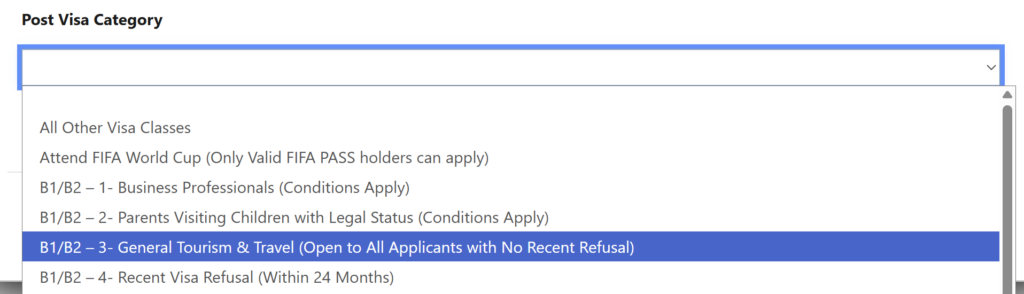
Now, some applicants are seeing four new sub-categories under B1/B2:
- Business Professionals (conditions apply)
- Parents Visiting Children with Legal Status (conditions apply)
- General Tourism & Travel (for applicants with no past refusals)
- Recent Visa Refusal (within 24 months)
At the moment, there’s no official explanation of what these “conditions” are.

It is worth noting here that, under the B1/B2 Visa, applicants traditionally selected just one combined visa type for:
- Business (B1)
- Tourism/visiting family (B2)
There was no official breakdown into sub-categories like the ones now appearing (business professionals, parents visiting children, etc.)
Double-Checks Your Answers
Here’s where it gets more interesting. After selecting a category and entering your DS-160 number, the system asks you to confirm that you’ve chosen the correct category. It also gives a subtle warning: If you provide incorrect or misleading answers, it could affect your visa eligibility.
Why Is This Happening?
There’s no official statement yet, but the likely reason is simple. The U.S. visa system is dealing with huge demand and long wait times, especially in India. This kind of categorisation could help:
- Sort applicants based on their background
- Separate first-time applicants from those with past refusals
- Speed up appointment scheduling
- Help embassies manage workload more efficiently
In short, it looks like a data-driven approach to handle high application volumes.
What This Could Mean for Applicants
If this trial expands to other cities, it could change how appointments are allocated. For example:
- Applicants with past refusals may be handled differently
- Parents visiting children might get prioritised or grouped separately
- A clean travel history could become more important than before
None of this is confirmed yet, but the structure suggests a more segmented system is coming.
Don’t Try to Game the System
This part matters. The system clearly warns applicants to answer honestly. And there’s a reason for that.
In the past, many US visa applicants tried to manipulate answers to get faster appointments. In several cases, this led to:
- Appointment cancellations
- Visa fees are being lost
- Profiles being flagged
So if you see these new categories, choose carefully and truthfully.
Is This Change Permanent?
Right now, this looks like a limited test, visible only to certain applicants. It’s not yet clear whether it will expand to other U.S. consulates across India or globally.
But if it does, it could reshape how B1/B2 visa applications are handled going forward.
Final Take
This isn’t a major overhaul yet, but it’s a clear sign of where things are heading. The U.S. visa process is becoming more structured, more data-driven, and possibly more selective in how applications are handled.
If you’re applying soon, keep an eye on these changes. And more importantly, make sure your application is accurate from the start.
Follow and connect with us on Facebook, Twitter, LinkedIn, Instagram and Google News for the latest travel news and updates!
The post Applying for a US Visa? New B1/B2 Categories Appear for Some Applicants in India appeared first on .


